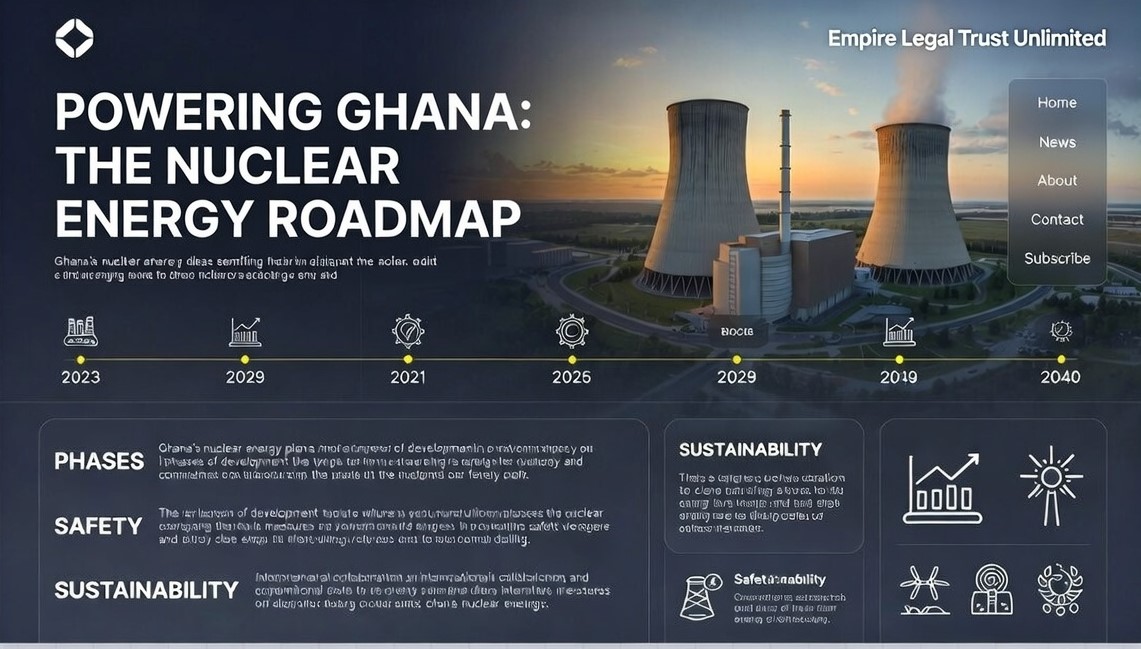
POWERING GHANA: THE NUCLEAR ENERGY ROADMAP
A Nation on the Brink of an Energy TransformationAs the 21st Century continues to redefine global energy landscapes, the strategic pursuit of nuclear energy stands out as one of the most transformativ...
POWERING GHANA: THE NUCLEAR ENERGY ROADMAP
A Nation on the Brink of an Energy Transformation
As the 21st Century continues to redefine global energy landscapes, the strategic pursuit of nuclear energy stands out as one of the most transformative pivots available to nations grappling with the dual pressures of sustainable development and industrial acceleration. Nowhere is this more pertinent than in Ghana; a West African country long recognized for its stable democracy and developmental ambition. Ghana is poised to become the second country on the African continent after South Africa to integrate nuclear energy into its national energy grid.
Currently, South Africa’s Koeberg Nuclear Power Station, housing two reactors, remains the continent’s only operational nuclear energy facility[1]. While Egypt is actively developing its own nuclear infrastructure, Ghana’s intentions to launch a commercial nuclear power plant by the early 2030s represents a paradigm shift in West African energy development. Under the stewardship of the Ministry of Energy and in partnership with the Ghana Atomic Energy Commission (GAEC) and the International Atomic Energy Agency (IAEA), Ghana is laying the groundwork for a clean, resilient and future-proof energy sector.
This article examines the rationale, progress, institutional framework, international collaborations and legislative imperatives shaping Ghana’s nuclear energy ambitions. It argues that the country’s nuclear agenda is not only a technical project but also a geopolitical and environmental strategy aimed at industrial growth, climate responsibility and regional power leadership.
I. Rationale for Nuclear Energy in Ghana: Developmental Imperatives and Energy Realities
Ghana’s choice to explore nuclear energy is rooted in a complex intersection of developmental ambition, fuel insecurity, climate commitments and regional energy dynamics. As of 2025, 84% of the population in Ghana has access to electricity. However, this figure marks significant disparities many communities are within electrified zones but remain unconnected due to personal or infrastructural limitations[2].
The current energy mix is dominated by thermal plants powered primarily by natural gas, which account for approximately 64% of total electricity production. This over-dependence on fossil fuels, many of which are subject to international price fluctuations and supply constraints, has led to recurring energy insecurity and economic volatility. Domestic gas reserves are also projected to begin declining by 2028, further straining the energy outlook[3].
Simultaneously, Ghana’s industrialization roadmap including aluminium smelting, iron ore processing and expansion of manufacturing requires a steady, high-capacity and reliable energy source. Nuclear power, with a typical capacity factor of 92% compared to 54% for natural gas, 34% for wind and 24% for solar, provides an optimal solution. It also complements Ghana’s aspiration to become a net exporter of electricity through the West African Power Pool (WAPP), a strategic framework under the Economic Community of West African States (ECOWAS) aimed at regional energy integration[4].
Moreover, as a signatory to the Paris Agreement, Ghana is bound by international obligations to reduce greenhouse gas emissions. Unlike thermal power, nuclear energy produces negligible greenhouse gases and offers a scalable pathway to decarbonize the national grid while meeting industrial energy needs[5].
II. Institutional Foundations: Building Human and Technical Capacities
Central to Ghana’s nuclear trajectory is the Ghana Atomic Energy Commission (GAEC), which has been actively coordinating with the IAEA and other international nuclear entities. GAEC, in collaboration with the University of Ghana, has established the Graduate School of Nuclear and Allied Sciences (GSNAS). This institution is designed to train the next generation of nuclear scientists, engineers and safety specialists; ensuring that Ghana’s nuclear ambition is supported by a robust human resource pipeline.[6]
Ghana’s participation in coordinated research projects under the IAEA has strengthened its technical expertise and global integration into nuclear knowledge networks. Through its involvement with the Global Nuclear Energy Partnership (GNEP) and other international forums, Ghana is ensuring that its nuclear journey is both domestically grounded and globally benchmarked[7].
In February 2025, Ghana hosted its first Site and External Events Design Review Service (SEED) mission, organized by the IAEA. The SEED mission involved nuclear experts from countries including the United States, Pakistan, Türkiye and the United Kingdom, which assessed the site selection process for Ghana’s first nuclear power plant. Two potential sites; one in the Western Region and another in the Central Region were evaluated based on criteria such as seismic safety, hydrological suitability and accessibility.
Following this assessment, Ghana successfully completed its site selection process and advanced into the site characterization phase. These steps, though largely technical, reflect Ghana’s commitment to international best practices and its reliance on evidence-based policy formulation.
III. Governance and Regulation: Toward a Comprehensive Nuclear Legal Framework
The effective and safe deployment of nuclear energy in Ghana depends heavily on a robust legal and regulatory framework. Presently, the country has made significant progress in planning but must consolidate this momentum by enacting specialized legislation that governs reactor construction, radioactive waste management, environmental protection, liability for nuclear damage and operational safety.
To this end, Ghana can draw valuable lessons from legislative precedents in advanced nuclear states such as the United Kingdom. Key legislative instruments worth adapting include:
- Atomic Energy Act, 1946 – establishing a national atomic energy authority.
- Atomic Energy Authority Acts of 1954 and 1986 – governing civil nuclear operations and organizational mandates.
- Nuclear Installations Act, 1965 (as amended by the 2016 Order) – addressing liability for nuclear damage and third-party claims.
- Radioactive Substances Act, 1993 – providing guidelines for the handling, transport and disposal of radioactive materials.
- Energy Acts (2004, 2008, 2013) – governing overall energy market structure, funding and innovation in low-carbon technologies.
- Nuclear Safeguards Acts (2000, 2018) – ensuring compliance with non-proliferation treaties and international safeguards.
Ghana must develop local legislation along these lines to empower a national nuclear regulatory authority, ensure public transparency, institutionalize environmental oversight and establish a legal infrastructure capable of handling contingencies and civil claims. Without this legal architecture, the deployment of nuclear energy could falter under governance and liability gaps.
IV. Safety Culture and Disaster Prevention: Avoiding the Chernobyl Precedent
One of the principal concerns in introducing nuclear power is the risk of catastrophic failure; most notoriously exemplified by the 1986 Chernobyl disaster in the former Soviet Union[8]. For Ghana, the prevention of such an event necessitates a multi-tiered strategy encompassing technical design, regulatory enforcement, emergency preparedness and human resource development.
First, reactor designs must incorporate passive safety systems capable of automatically shutting down or cooling the reactor without human intervention during emergencies. These inherently safe reactors are a significant evolution in reactor technology and will be critical for Ghana’s context, where operational experience is still being developed.
Second, the establishment of an independent and well-resourced nuclear regulatory authority is non-negotiable. This body must be equipped to enforce safety protocols, conduct routine inspections and impose penalties for non-compliance.
Third, continuous capacity building through training, simulations and regional cooperation will be vital. Ghana should maintain open channels of communication with international organizations such as the IAEA, the World Association of Nuclear Operators (WANO) and experienced national agencies in countries such as Japan, France and the USA[9].
Finally, public education and stakeholder engagements must be integrated into the national nuclear policy to prevent misinformation and to build societal trust in nuclear technologies.
V. Socio-Economic and Environmental Impacts: Energy Justice and Climate Action
The successful deployment of nuclear energy has far-reaching socio-economic benefits. First and foremost, it enables a reliable and constant power supply that is critical to industrial growth, job creation and rural electrification. Nuclear plants can serve as economic anchors in their localities, generating employment not only in plant operation but in associated supply chains, education and infrastructure.
Second, the shift to nuclear energy allows Ghana to reduce its dependence on imported fuels, insulating its economy from international price shocks. As fossil gas reserves dwindle, nuclear power provides a domestic and sustainable alternative.
Third, nuclear power is a keystone of Ghana’s climate change strategy. It enables the country to meet its Paris Agreement obligations while maintaining industrial competitiveness. Unlike renewables such as solar and wind, nuclear energy can provide baseload power without the need for extensive battery storage or backup systems.
Importantly, nuclear energy also strengthens regional diplomacy. Ghana’s leadership in nuclear development within the ECOWAS region positions it as a technological innovator and an energy exporter, thereby enhancing its geopolitical capital and economic influence.
Conclusion: A Nation at the Crossroads of Innovation and Responsibility
Ghana’s journey into nuclear energy is both a national imperative and a continental milestone. As the second African country to pursue nuclear power generation, Ghana is setting a precedent for sustainable energy transitions in the Global South. Through strategic planning, international collaboration, institutional capacity building and legal modernization, the country is crafting a nuclear agenda that aligns with its industrial aspirations, environmental responsibilities and regional ambitions.
The path ahead is complex and demands careful coordination of engineering, governance, diplomacy and public engagement. But if managed effectively, Ghana’s nuclear future can power more than just its electrical grid; it can ignite an era of prosperity, stability and environmental stewardship for generations to come. The country is ready, the frameworks are emerging and the time for implementation is now. Ghana is not merely pursuing nuclear power; it is pioneering Africa’s sustainable energy revolution.
[1] Nuclear Reactor Uses Only Low Enriched Uranium (LEU) for the First Time, South African Nuclear Energy Corporation media release (29 June 2009). See also announcement from 2005: Minister of Minerals and Energy announces the phasing out of the use of High Enriched Uranium for the Pelindaba Research Reactor Nuclear Fuel, Department of Minerals and Energy statement (18 July 2005)
[2] https://www.energycom.gov.gh/planning/energy-statistics#
[3] Nyasapoh, Mark Amoah, Seth Kofi Debrah, Daniel Kwabena Twerefou, Samuel Gyamfi, and Foster Kwame Kholi. "An overview of energy resource and future concerns for Ghana’s electricity generation mix." Journal of Energy 2022, no. 1 (2022): 1031044.
[4] ibid
[5] Arkoh, Robert Junior. "A study on how Ghana can develop and implement a strategy for renewable energy in the perspective of the United Nations' Sustainable Development Goals and the Paris Climate Agreement." Master's thesis, NTNU, 2016.
[6] Ghana Atomic Energy Commission, 1998. Ghana Atomic Energy Commission: at a glance. 3 (No. INIS-GH--007). Ghana Atomic Energy Commission, Accra (Ghana).
[7] Gombert, D., Ebert, W., Marra, J., Jubin, R. and Vienna, J., 2008. Global nuclear energy partnership waste treatment baseline (No. INL/CON-08-13917). Idaho National Lab.(INL), Idaho Falls, ID (United States).
[8] Saenko, V., Ivanov, V., Tsyb, A., Bogdanova, T., Tronko, M., Demidchik, Y. and Yamashita, S., 2011. The Chernobyl accident and its consequences. Clinical Oncology, 23(4), pp.234-243.
[9] Revuelta, R., 2004. Operational experience feedback in the World Association of Nuclear Operators (WANO). Journal of hazardous materials, 111(1-3), pp.67-71.