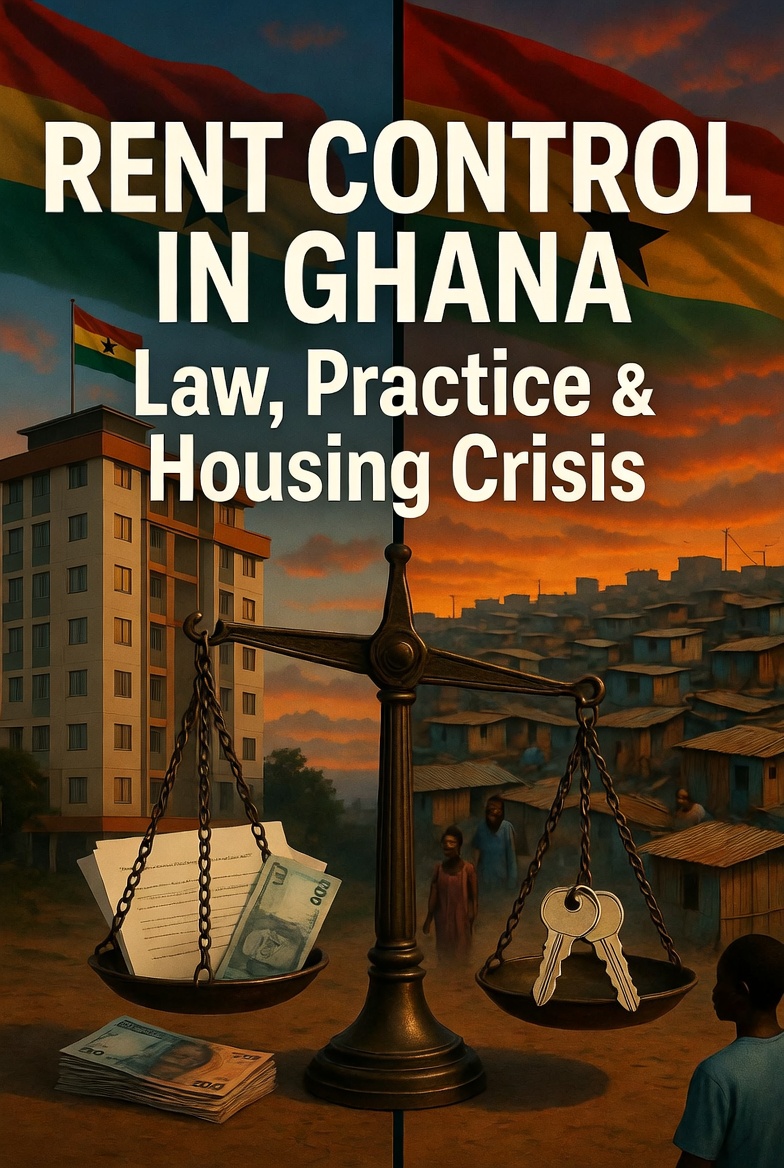
Rent Control in Ghana: Law, Practice and the Housing Challenge
Access to decent, safe, and affordable housing has become one of the most pressing social and economic challenges not only in Ghana but across the world generally. Housing is a basic human necessity c...
Rent Control in Ghana: Law, Practice and the Housing Challenge
Access to decent, safe, and affordable housing has become one of the most pressing social and economic challenges not only in Ghana but across the world generally. Housing is a basic human necessity closely connected to dignity, security, and quality of life. However, for many individuals and families, particularly in rapidly developing urban centers, obtaining suitable accommodation has become increasingly difficult. In Ghana, the situation has become especially alarming as urban populations continue to expand in major cities such as Accra, Kumasi, Sekondi-Takoradi, and Tamale. The growing migration of people into these cities in search of employment, education, and better living opportunities has significantly increased the demand for rental accommodation.
Unfortunately, the supply of affordable housing has not increased at the same rate as the demand. This imbalance has resulted in persistently rising rent prices, making accommodation unaffordable for many low and middle-income earners. Students, young professionals, newly employed graduates, and even families with stable incomes often struggle to secure accommodation because of the excessive financial demands imposed by landlords. In many instances, tenants are required to pay huge sums of money as advance rent before they are allowed to occupy premises, placing enormous economic pressure on ordinary citizens.
One troubling aspect of the rental market in Ghana is that rent charges often appear to lack any clear uniformity or standardized basis. In practice, rental prices are frequently determined arbitrarily depending on the discretion of individual landlords rather than any transparent or regulated formula. Two properties with similar conditions and located within the same neighborhood may attract drastically different rental charges without any objective justification. In some cases, landlords increase rents suddenly and excessively merely because demand for accommodation is high, without considering the economic circumstances of tenants or the actual value of the property. This absence of standardization has contributed significantly to uncertainty and exploitation within the rental sector.
Although many landlords justify these increases on the basis of economic hardship and rising property maintenance costs, Ghanaian law does not permit arbitrary rent increments without regulation. Section 19 of the Rent Act, 1963 (Act 220) specifically regulates rent increases resulting from increases in rates.[1] Under the provision, a landlord is prohibited from collecting increased rent attributable to increased rates unless the tenant has first been notified in writing of the old rates, the new rates, the amount attributable to the tenant, the amount of the increase, and the date on which the increase is to take effect. Furthermore, where only part of a premises is rented out, the landlord cannot impose an increase unless the amount has first been approved by the Rent Officer. These provisions demonstrate that rent increments are intended to be supervised and justified rather than imposed solely at the discretion of landlords.
The Act goes further by criminalizing several exploitative rental practices. Section 25 of the Act makes it an offence for landlords to demand or receive rent in excess of the lawful recoverable rent, impose unlawful charges connected to tenancy agreements, or eject tenants for refusing to comply with illegal rent demands. Particularly significant is section 25(5), which prohibits excessive advance rent payments. The provision states that in the case of monthly or shorter tenancies, landlords cannot lawfully demand more than one month’s rent in advance, while in tenancies exceeding six months, advance payments cannot exceed six months’ rent.[2] A landlord who contravenes these provisions commits an offence and may be liable upon conviction to fines imposed by the Rent Magistrate.
Despite these statutory safeguards, the practical realities within the Ghanaian rental market often differ significantly from the legal framework. In many urban communities, tenants continue to face demands for two to five years’ advance rent as a condition for securing accommodation. Because housing remains scarce and highly competitive, many tenants feel compelled to comply with these unlawful demands even where they are aware of their legal rights.
Many tenants are unaware that under Ghanaian rent laws, landlords are not permitted to increase rent arbitrarily or unilaterally without following the appropriate legal procedures. Under the existing rent control framework, rent increments are expected to be subject to regulation and oversight by the Rent Control Department to ensure that increases are reasonable and justifiable. This legal protection exists to prevent exploitation and to maintain some level of fairness within the landlord-tenant relationship. Importantly, these protections extend not only to private residential accommodation but also to hostel facilities and rented premises occupied by students and young people.
Rent in Ghana is regulated by Rent Control Department (RCD), which operates under the Ministry of Works and Housing. The RCD enforces the Rent Act 220 (1963).
The Rent Act, 1963 (Act 220), remains one of the principal legal frameworks regulating tenancy relationships in Ghana.[3] It was enacted to control rent increases, regulate tenancy conditions, and provide legal mechanisms for resolving disputes. The law established the Rent Control Department as the body responsible for enforcing rent regulations and addressing complaints from both landlords and tenants.[4] Its purpose was to ensure that accommodation remained reasonably accessible while balancing the legitimate interests of landlords.
The legal framework governing tenancy has also been reinforced by the Land Act, 2020 (Act 1036),[5] which modernizes leasehold law in Ghana. Section 34 of the Act requires contracts involving the transfer of interests in land to be in writing and signed by the relevant parties, while section 35 makes clear that transfers made outside the prescribed legal form do not confer valid legal interests unless exempted under section 36. This strengthens certainty in tenancy arrangements and seeks to reduce informal disputes that often arise from unwritten rental agreements.
Despite these legal protections, one of the most persistent challenges in Ghana’s rental sector is the issue of advance rent. In many parts of the country, landlords demand rent payments covering two to five years in advance before granting possession to tenants. This practice places severe financial burdens on ordinary citizens, especially recent graduates, students, and young professionals. For many tenants, raising such sums requires borrowing, family assistance, or prolonged financial hardship.
This practice continues largely because of weak enforcement of rent laws. Although the Rent Control Department has authority to investigate complaints and intervene in disputes, its effectiveness has often been questioned due to limited personnel, inadequate logistical support, and slow complaint resolution processes. Many tenants also hesitate to report violations for fear of victimization or eviction. The result is that unlawful rental practices frequently go unchallenged.
The problem is further complicated by the economic realities landlords face. Property maintenance costs have risen significantly due to inflation, utility increases, and expensive construction materials. Many landlords argue that large advance payments provide financial security and enable them to maintain their properties. Their concerns reflect broader structural weaknesses within Ghana’s housing economy rather than mere opportunism.
The Land Act also places important limits on how landlords may recover possession of rented property. Under section 57, a landlord cannot lawfully enforce forfeiture or re-entry for breach of covenant unless proper notice has first been served specifying the breach, requiring remedy where possible, and giving the tenant reasonable time to comply. Even where non-payment of rent is involved, tenants must be given the opportunity to pay outstanding rent and interest before repossession can lawfully occur.
This provision is reinforced by section 58, which gives tenants and subtenants the right to apply to court for relief against forfeiture. The court may grant relief depending on the conduct of the parties and surrounding circumstances, often imposing conditions it considers just. This ensures that eviction is not left entirely to the discretion of landlords and protects tenants from arbitrary loss of possession.
These statutory protections reflect an important principle in Ghanaian tenancy law: rental relationships are legal relationships governed by rights and obligations, not merely private arrangements subject to unilateral landlord control. The law expects both parties to act in good faith and provides judicial remedies where disputes arise.
Yet legal protection alone cannot solve Ghana’s rental crisis. The underlying problem remains the country’s housing deficit.[6] Rapid urbanization, high land prices, expensive building materials, and insufficient affordable housing projects have created demand far beyond available supply. As long as accommodation remains scarce, landlords retain significant bargaining power, often enabling them to impose conditions tenants cannot easily resist.
This raises an important question: is rent control still effective in modern Ghana? Supporters argue that it remains essential for protecting vulnerable tenants and preserving social stability. Without legal regulation, rent inflation could become even more severe, making housing inaccessible for many Ghanaians.
Critics, however, argue that some aspects of rent regulation no longer reflect economic realities. They contend that excessive restrictions discourage private investment in rental housing and contribute to informal market practices that undermine legal compliance. This suggests that reform may be necessary, not to abolish rent control, but to adapt it to contemporary economic conditions.[7]
For rent control to function effectively in Ghana, enforcement institutions must be strengthened. The Rent Control Department requires better funding, wider public accessibility, and stronger administrative authority. Public education must also improve so tenants understand their rights and landlords appreciate their legal obligations. At the same time, government and private developers must expand affordable housing initiatives to reduce pressure on the rental market.
CONCLUSION
Ultimately, rent control in Ghana reflects a larger struggle between legal protection and economic reality. The law, as reflected in the Rent Act and the Land Act, provides meaningful safeguards for tenants, including formal lease requirements, notice protections, and access to judicial relief. However, until housing supply improves and enforcement becomes more effective, many Ghanaians will continue to experience serious difficulties securing decent and affordable accommodation.[8] The challenge is therefore not simply legal reform, but broader structural transformation of Ghana’s housing sector.
[1] Section 19 Rent Act, 1963 (Act 220)
[2] Section 25 Rent Act, 1963 (Act 220)
[3] Malpezzi, S., Tipple, A. G., & Willis, K. G. (1990). Costs and benefits of rent control: a case study in Kumasi, Ghana (No. 64). World Bank Publications.
[4] ibid
[5] Asiama, O., & Kutir, M. M. The Land Act, 2020 (Act 1036) and compulsory acquisition in Ghana: Stakeholders' perspective.
[6] Dramani, J. B., Frimpong, P. B., & Adusah-Poku, F. (2026). A look at Ghana’s housing deficit and quality trends for over 20 years. Housing Studies, 41(5), 996-1020.
[7] https://www.ghanaweb.com/GhanaHomePage/business/Rent-Control-to-introduce-standardised-tenancy-agreement-2033047
[8] Adjei, B. A., & Mensah, L. (2015). Ghana’s efforts at environmental enforcement networks: legal and institutional structures. In Environmental Enforcement Networks (pp. 419-429). Edward Elgar Publishing.