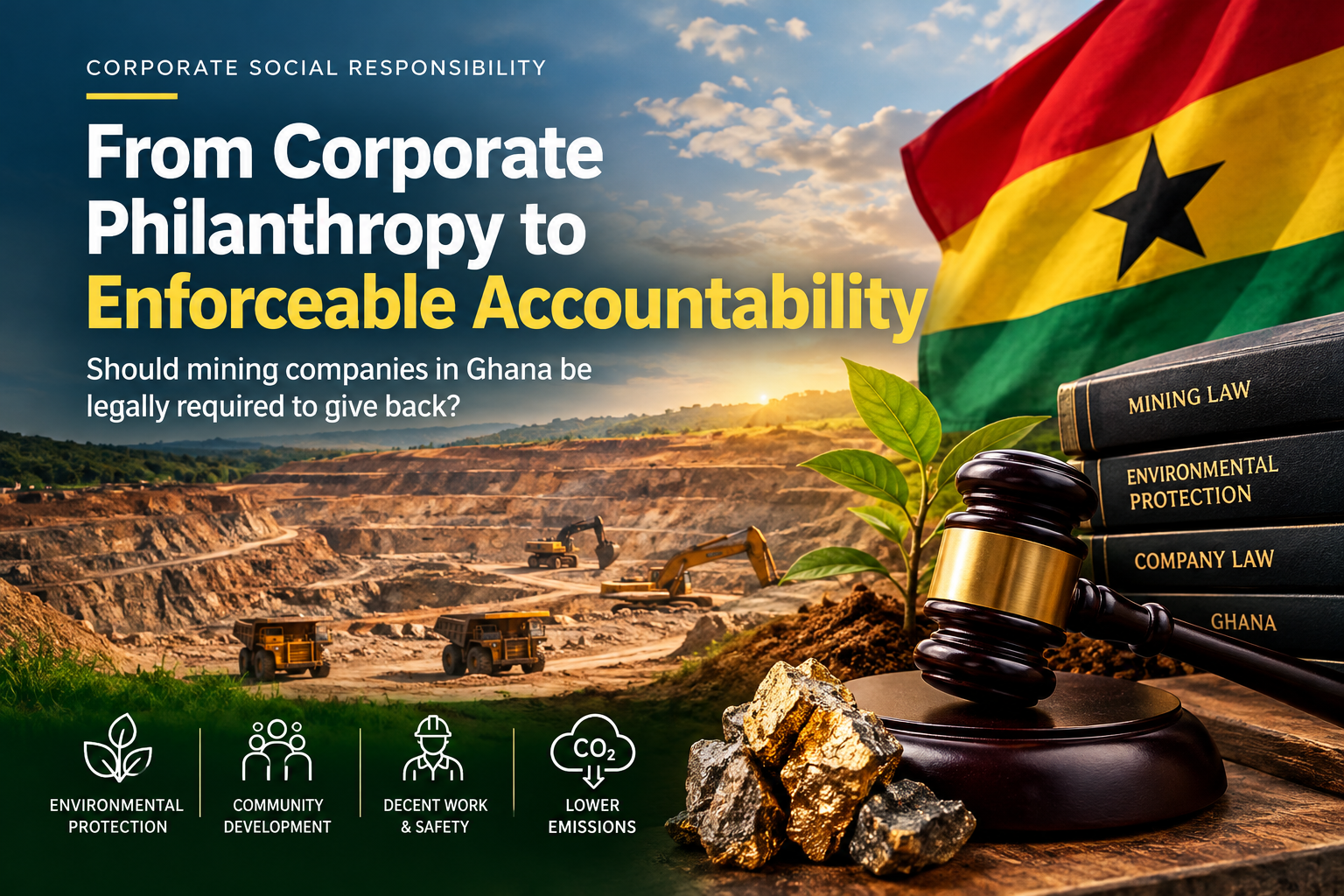
Corporate Social Responsibility in Ghana: From Corporate Philanthropy to Enforceable Accountability
IntroductionCorporate Social Responsibility (CSR) has become an important feature of contemporary corporate governance, particularly in developing economies where private enterprise operates alongside...
Corporate Social Responsibility in Ghana: From Corporate Philanthropy to Enforceable Accountability
Introduction
Corporate Social Responsibility (CSR) has become an important feature of contemporary corporate governance, particularly in developing economies where private enterprise operates alongside persistent challenges in environmental protection, employment, inequality and access to essential services. In Ghana, however, an important legal question remains unresolved: should a company's responsibility towards society depend principally on its goodwill, or should the law require businesses to make a measurable contribution to the communities and environment from which they derive their profits?
The question is especially significant in the extractive industry. Mining generates employment, foreign exchange, tax revenue and infrastructure investment, yet it can also contribute to land degradation, water pollution, biodiversity loss and greenhouse gas emissions. These consequences raise a fundamental question of corporate justice: should the benefits of extracting Ghana's natural resources accrue predominantly to companies and the state, while communities bear a disproportionate share of the environmental and social costs?
Ghana must move beyond measuring corporate responsibility by what companies donate to society and begin measuring it by what they are legally required to prevent, repair and contribute towards sustainable development.
The legal foundations of corporate responsibility in Ghana
CSR in Ghana is not governed by one comprehensive statute imposing a uniform obligation on all companies to undertake community development initiatives. Instead, the relevant legal framework consists of corporate governance rules, environmental legislation, labour protections and industry-specific obligations.
Article 257(6) of the 1992 Constitution vests minerals in their natural state in the Republic and in the President on behalf of and in trust for the people of Ghana. This constitutional arrangement is important because mineral exploitation is not merely a private commercial activity. It concerns resources held for the benefit of the Ghanaian people. Article 36(9) further directs the State to take appropriate measures to protect and safeguard the national environment for posterity. Together, these provisions provide a constitutional foundation for examining whether the economic benefits of mineral extraction are consistent with the public interest and the protection of future generations.[1]
The Minerals and Mining Act, 2006 (Act 703), as amended, regulates mineral operations, while the Environmental Protection Act, 2025 (Act 1124), establishes the contemporary statutory framework for environmental protection and the coordination of climate change responses.[2] The Companies Act, 2019 (Act 992), meanwhile, provides the framework for corporate governance and directors' duties. These laws should not be conflated with a universal CSR mandate: compliance with environmental permits, rehabilitation obligations and other statutory duties is legally distinct from voluntary philanthropy.
Nevertheless, Ghana already recognises aspects of structured community development in its mining governance. The Minerals Development Fund Act, 2016 (Act 912), and the Mining Community Development Scheme provide mechanisms for supporting the socioeconomic development of mining-affected communities. The Minerals Development Fund describes the scheme as a framework for selecting infrastructure and development projects through local management committees and community engagement.[3] The central challenge is therefore not whether community development belongs in mining governance, but whether existing arrangements are sufficiently comprehensive, enforceable and responsive to the actual costs of mining.
Why mining and mining-related companies require particular attention
The case for stronger corporate responsibility is particularly compelling in mining because the environmental consequences of extraction can persist long after commercial operations end. Large-scale gold mining companies such as Newmont, AngloGold Ashanti and Gold Fields operate within a sector whose activities can affect land use, water resources, energy consumption and surrounding livelihoods. Similar concerns arise in quarrying, mineral processing, smelting, heavy-equipment operations, mining logistics and the transportation of extracted minerals.
These activities do not all produce identical environmental impacts, and their legal obligations should reflect their particular operations. Nevertheless, companies that conduct or materially contribute to high-impact industrial activities should be assessed according to the risks they create, rather than the generosity of their charitable programmes.
A company may construct a school, award scholarships or provide community boreholes and still fall short of meaningful social responsibility if its operations damage agricultural land, compromise water quality or leave inadequate resources for site rehabilitation. Such initiatives may have genuine social value, but they cannot compensate automatically for environmental damage or excuse non-compliance with the law.
This distinction is supported by Ghanaian scholarship. Nathan Andrews, in his examination of CSR and mining regulation in Ghana, identifies the difficulties created by the absence of sufficiently clear domestic regulatory mechanisms for CSR and argues for stronger institutional guidance and enforcement.[4] Similarly, research by Marcellinus Essah and Nathan Andrews highlights the disconnect that can arise between mining companies' understandings of sustainability and the experiences of affected communities, particularly where corporate programmes are fragmented or community participation is inadequate.[5]
The implication is clear: CSR must be evaluated not merely by corporate announcements or expenditure figures, but by independently verifiable outcomes, meaningful community participation and accountability for adverse impacts.
Is it time to make CSR compulsory?
There is a strong case for requiring certain categories of companies to undertake defined social and environmental responsibilities as a condition of operating in Ghana. However, the proposal requires conceptual precision. Making CSR compulsory should not mean compelling every company to donate an arbitrary percentage of its profits to charity. It should mean establishing enforceable minimum obligations proportionate to the nature, scale and risks of corporate activity. And for certain industries whose activities cause harm to the environment, CSR definitely should be mandatory.
For mining companies and other high-impact businesses, such obligations could include transparent community development agreements, independently verified environmental and social performance reports, measurable emissions-reduction plans, adequate mine-closure and rehabilitation financing, and structured participation by affected communities in identifying development priorities.
The legal justification is stronger where these obligations address foreseeable harm or the distribution of costs arising from commercial operations. For example, rehabilitation and pollution-control requirements are not charitable contributions. They are mechanisms for ensuring that companies internalise the environmental costs of their activities instead of transferring them to the public. Community development obligations, by contrast, may require a distinct statutory or contractual basis, with clearly defined beneficiaries, funding arrangements and accountability procedures.
A compulsory framework could also require high-emitting companies to measure and disclose their greenhouse gas emissions and demonstrate credible progress towards reduction targets. This would be particularly relevant to energy-intensive mineral processing, heavy industrial operations and businesses dependent on carbon-intensive transport and machinery. Such requirements should complement existing environmental regulation rather than be presented as though CSR itself creates a universal legal obligation to reduce emissions.
The distinction matters because a company's carbon footprint is only one dimension of its environmental impact. A credible responsibility framework must also address water contamination, waste management, biodiversity, land restoration and the social consequences of industrial operations.
Enforcement: The Real Test of Corporate Responsibility
The effectiveness of mandatory CSR would depend on the credibility of its enforcement. Ghana does not necessarily need to create an entirely separate regulatory system. Rather, it could strengthen coordination among existing institutions, including the Environmental Protection Authority, the Minerals Commission, local government authorities and the Minerals Development Fund.
The framework should require public reporting of relevant obligations, independent verification of performance, accessible complaint mechanisms and meaningful sanctions for non-compliance. Community development funds should be transparently administered, while affected residents should have a meaningful role in selecting projects and evaluating their results. Environmental rehabilitation obligations should be supported by adequate financial security so that the public is not left to bear the costs when a company ceases operations.
The constitutional protection of mineral resources for the people and the State's environmental responsibilities provide a principled basis for this approach. Yet these principles must be translated into workable statutory duties, adequately resourced oversight and effective remedies. The existence of legislation alone does not establish that affected communities receive adequate protection.
The need for continued reform is especially timely. In July 2026, Ghana's Ministry of Lands and Natural Resources announced that Cabinet had endorsed a comprehensive review of Act 703 and forwarded it to Parliament for consideration. The proposed reforms include stronger community involvement in mining governance and community development agreements.[6] These proposals should not be confused with enacted law, but they provide an opportunity to consider whether community development obligations should become more clearly defined and enforceable within the mining regime.
Balancing accountability with commercial fairness
Mandatory CSR must nevertheless be designed carefully. An inflexible levy could impose disproportionate burdens on smaller or financially vulnerable operators, encourage superficial compliance or duplicate existing taxes, royalties and statutory contributions. The Ghana Chamber of Mines has raised concerns about proposals for compulsory community development agreements linked to a levy of one per cent of gross mineral revenue, arguing that such a measure could increase costs and fail to account adequately for differences in financial capacity.[7]
These concerns deserve consideration, but they do not settle the underlying question. The appropriate response is to design a proportionate and transparent framework, not to assume that voluntary corporate discretion will always deliver equitable outcomes. Legislators could distinguish between large-scale mining, medium-scale operations and ancillary businesses according to their environmental impact, financial capacity and contribution to community risks.
The framework should also distinguish between mandatory environmental and social safeguards, enforceable community development commitments, and genuinely voluntary charitable activities. This would prevent companies from presenting compliance with existing legal duties as exceptional generosity while preserving room for initiatives that go beyond minimum standards.
Conclusion
The future of CSR in Ghana should be determined by a more demanding conception of corporate accountability. Companies should not be judged solely by their charitable donations, sponsorships or public commitments, but by whether their operations comply with the law, protect affected communities, minimise environmental harm and contribute fairly to sustainable development.
For mining companies and other businesses with substantial environmental footprints, the case for compulsory minimum standards is particularly strong. Their commercial activities can generate consequences that extend beyond the life of a project, making voluntary commitments an insufficient substitute for enforceable safeguards.
The objective is not to turn companies into substitutes for government or to make philanthropy compulsory. It is to ensure that businesses cannot externalise the costs of their operations while retaining the benefits. Ghana's evolving mining law provides an opportunity to establish clearer obligations, stronger enforcement and meaningful community participation.
The central question is no longer simply whether companies should give back to society. It is whether the law should require them to account for the social and environmental costs of the wealth they generate. For high-impact industries, that question deserves a clear and enforceable legislative answer.