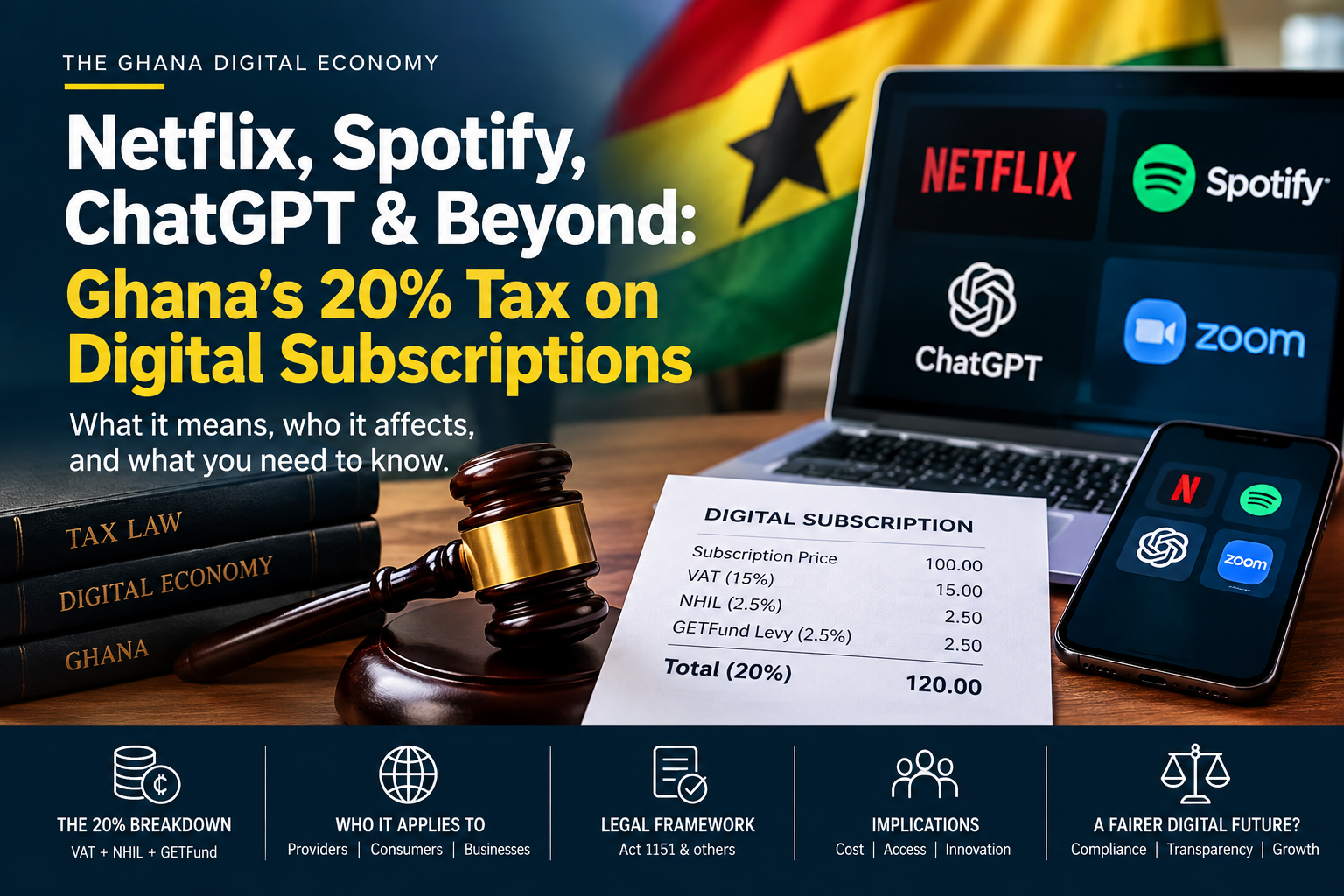
Taxing the Digital Economy: The Legal and Economic Implications of Ghana's 20% Tax on Digital Subscriptions
 IntroductionFrom watching a film on Netflix to listening to music on Spotify, attending meetings through Zoom or using artificial intelligence tools such as ChatGPT, digital services have become...
Taxing the Digital Economy: The Legal and Economic Implications of Ghana's 20% Tax on Digital Subscriptions
Introduction
From watching a film on Netflix to listening to music on Spotify, attending meetings through Zoom or using artificial intelligence tools such as ChatGPT, digital services have become an integral part of modern life. Yet, as Ghana's economy becomes increasingly digital, a fundamental question of taxation has emerged: how should the law tax services consumed in Ghana but supplied by companies operating largely outside its borders?
On 15 October 2026, Ghana began implementing an enhanced mechanism for collecting an effective 20% tax on qualifying cross-border digital services through participating banks and payment service providers. The development has generated public concern about the potential increase in the cost of digital subscriptions. However, the Ghana Revenue Authority (GRA) has clarified that the measure does not introduce a new tax or increase the existing rates. Instead, it changes the collection mechanism for taxes already applicable to qualifying digital services supplied by non-resident companies.[1]
The distinction is legally significant. The central issue is not the introduction of a new digital tax, but the enforcement and collection of existing tax obligations in an economy where commercial transactions increasingly take place across borders without physical presence. Nevertheless, even a change in collection arrangements can have significant implications for consumers, businesses, education, innovation and the future of Ghana's digital economy.
1. Understanding the 20% tax: What exactly is being charged?
The expression “20% digital tax” may suggest that Ghana has introduced a special tax exclusively targeting online subscriptions. That is not an accurate description of the October 2026 development.
The applicable effective rate comprises three statutory components:
- Value Added Tax (VAT): 15%. A consumption tax imposed on qualifying taxable supplies of goods and services.
- National Health Insurance Levy (NHIL): 2.5%. A statutory levy supporting Ghana's National Health Insurance Scheme.
- Ghana Education Trust Fund (GETFund) Levy: 2.5%. A statutory levy supporting education-related expenditure.
Together, these components produce an effective rate of 20% under the current framework.[2]
The relevant legislative framework includes the Value Added Tax Act, 2025 (Act 1151), which took effect on 1 January 2026, alongside the applicable legislation governing the NHIL and GETFund Levy.[3]
Consider a subscription priced at GH¢100 before applicable taxes. Where the full 20% applies and has not already been included in the price, the calculation is:
| Item | Amount
| Subscription price | GH¢100.00
| VAT at 15% | GH¢15.00
| NHIL at 2.5% | GH¢2.50
| GETFund Levy at 2.5% | GH¢2.50
| Total payable | GH¢120.00
The example assumes that the subscription price is tax-exclusive and that all three components apply to the transaction. The actual amount charged depends on the provider's pricing arrangements and the applicable tax treatment.
This distinction is important because the tax is not necessarily an additional 20% on top of every existing subscription price. If the relevant taxes have already been accounted for, the new collection system should not result in the same tax being charged a second time.
2. Why are Netflix, Spotify and ChatGPT affected?
The legal foundation for taxing digital services lies in the principle that consumption occurring within Ghana may be subject to Ghanaian taxation even where the supplier is established abroad.
Traditionally, tax administration was closely associated with identifiable physical businesses, premises and domestic transactions. Digital commerce complicates this model. A consumer in Accra may purchase a subscription from a company headquartered in another country, receive the service instantly and pay using a Ghana-issued bank card or mobile money.
The absence of a physical establishment in Ghana does not, by itself, mean that a supplier's electronically supplied services are outside the Ghanaian VAT framework. Ghana has already established a system for registering non-resident suppliers of electronic services and collecting applicable taxes.[4]
The October 2026 arrangement strengthens the collection process by involving participating financial institutions and payment service providers. Instead of relying exclusively on foreign suppliers to identify taxable transactions, declare the applicable taxes and remit the amounts due, the system enables the tax component of qualifying payments to be identified and collected at the payment stage.[1]
This is an important development in digital tax administration. It illustrates how governments are adapting traditional tax rules to transactions in which the supplier, customer and payment intermediary may all be located in different jurisdictions.
3. Scope of application: Which services are covered?
The measure is directed at qualifying electronically supplied services provided by non-resident businesses for use or enjoyment in Ghana. The fact that a service is accessible through the internet does not automatically mean that every associated transaction receives identical tax treatment.
Examples of potentially affected services include:
Entertainment and streaming: Netflix, Spotify, Disney+ and Showmax subscriptions.
Artificial intelligence and productivity: ChatGPT subscriptions, Microsoft 365, Adobe services and Zoom.
Cloud computing and digital infrastructure: qualifying cloud-hosting, storage and computing services.
Digital advertising: qualifying advertising services purchased from international digital platforms.
Other electronic services: certain online gaming, cybersecurity, digital education and business communication services, depending on the transaction and the applicable rules.[5]
The scope is not confined to individual consumers. Businesses, researchers, educational institutions and organisations that purchase qualifying services from non-resident providers may also be affected.
However, the new collection arrangement should not be interpreted as imposing the same tax on every online transaction. The relevant questions include whether the supply is taxable, whether it falls within the applicable electronic-services framework, whether the supplier or transaction is already properly accounted for, and whether the relevant taxes have already been charged.
Imported physical goods purchased through international e-commerce platforms are also distinct from electronically supplied services. Such goods remain subject to the applicable customs and import-tax procedures rather than being automatically covered by this digital-services collection arrangement.[1]
4. The legal implications: Collection is not the same as creating a tax
One of the most important legal concepts raised by this development is the distinction between the imposition of a tax and the administration of a tax.
The imposition of a tax concerns the legal authority to establish a tax liability, including the relevant taxable transaction, rate and person responsible. Tax administration concerns how that liability is identified, collected, reported and transferred to the state.
Article 174(1) of the 1992 Constitution provides that no taxation shall be imposed otherwise than by or under the authority of an Act of Parliament. Article 174(2) further addresses the waiver or variation of taxes.[6] These provisions reflect the constitutional principle that taxation must have a lawful parliamentary foundation.
Consequently, the involvement of banks in collecting the applicable taxes does not, by itself, create a new tax. The legal question is whether the collection mechanism operates within the authority conferred by the relevant legislation and applicable administrative arrangements.
The distinction also has implications for accountability. Consumers should be able to identify the tax component of a transaction, understand why it applies and challenge an erroneous charge. Banks and payment providers should communicate the basis of the deductions clearly, while the GRA should provide accessible mechanisms for resolving disputes.
The government must therefore ensure that improved collection does not become an excuse for opaque charges or the duplication of existing tax liabilities.
5. Implications for consumers
The economic consequences will depend partly on whether a particular subscription was previously being taxed and whether the supplier has already included the applicable taxes in its price.
For consumers whose subscriptions were not previously attracting the required taxes, the effective cost may increase when the taxes begin to be reflected in their payments. For those already paying the applicable taxes, the new collection system should not generate a duplicate charge on the same taxable transaction.[1]
The implications extend beyond entertainment.
Students and researchers increasingly depend on digital libraries, online learning platforms, research databases, productivity software and AI-assisted tools. Where these services fall within the taxable category, additional costs may affect access, particularly for individuals operating on limited budgets.
Businesses may also face higher expenditure on software licences, cloud infrastructure, digital advertising and communication tools where the applicable taxes were not previously being charged. Small enterprises and start-ups that depend on foreign digital services may experience this most acutely because their operating budgets are often limited.
Nevertheless, it would be incorrect to conclude that every digital service will become 20% more expensive. The actual impact depends on prior tax treatment, contractual pricing and whether the relevant taxes have already been included.
The policy challenge is therefore to reconcile effective revenue collection with the affordability of essential digital tools. Clear pricing, accurate invoices and consistent application of the law are central to that balance.
6. Fair competition and tax neutrality
The measure also raises a question of competitive fairness. A domestic business supplying taxable services may be required to charge and remit applicable taxes under Ghanaian law. If a comparable foreign supplier serves Ghanaian customers without accounting for the same taxes, the foreign supplier may enjoy a pricing advantage that does not arise from greater efficiency but from differences in tax compliance.
Bringing non-resident suppliers into the tax system can therefore support the principle of tax neutrality: comparable taxable consumption should generally receive comparable tax treatment, regardless of where the supplier is established.
The GRA reported on 14 October 2026 that approximately 92 non-resident digital service providers were already registered and remitting VAT, while identifying about 100 additional providers to be progressively brought into compliance.[1] These figures suggest that the implementation challenge concerns not only consumers but also the consistency of compliance across a large and changing digital marketplace.
However, neutrality must be achieved through fair and predictable administration. Foreign suppliers should receive clear guidance, and domestic consumers should not bear the consequences of inconsistent implementation or errors in the collection system.
7. Revenue mobilisation and the public interest
From the government's perspective, the policy is part of a broader effort to improve domestic revenue mobilization. As digital consumption expands, a failure to collect taxes already authorised by law can leave gaps in the tax system and undermine the fairness of public revenue collection.
The revenue generated may contribute to the financing of public services through the applicable statutory arrangements. Nevertheless, the collection of these taxes does not mean that each individual payment is directly earmarked for a particular hospital, school or public project. The relevant revenue allocation depends on the governing fiscal framework.
The broader public-interest question is whether Ghana can modernize its tax administration while maintaining transparency, protecting consumers and supporting the growth of digital commerce.
A successful system must do more than collect revenue. It should also improve compliance, reduce uncertainty, provide clear information and ensure that taxpayers can seek redress when mistakes occur.
8. The way forward: Transparency, proportionality and effective redress
The legal legitimacy of this collection mechanism will depend on more than its revenue-generating potential. Its implementation should be accompanied by clear public guidance on taxable services, the responsibilities of banks and payment providers, and the treatment of subscriptions for which taxes have already been paid.
First, consumers should receive sufficiently detailed payment information to distinguish the subscription price from applicable taxes. Second, banks and payment providers should have clear procedures for addressing duplicate or incorrect charges. Third, the GRA should maintain accessible channels for complaints and provide timely explanations of disputed assessments. Finally, businesses and consumers should be able to obtain reliable guidance on whether particular services fall within the relevant tax rules.
These safeguards would promote confidence in the tax system while preserving the government's ability to collect revenue lawfully due.
Conclusion
Ghana's October 2026 digital-services tax collection development reflects a wider transformation in the relationship between taxation and technology. As economic activity becomes increasingly digital and cross-border, governments must adapt their administrative systems to ensure that existing tax obligations remain enforceable.
The effective 20% rate on qualifying digital services is not, according to the GRA, a newly introduced tax. It comprises existing VAT and statutory levies whose collection is being strengthened through participating financial institutions and payment providers. Yet the absence of a new tax does not make the change economically insignificant. Consumers who were not previously paying the applicable taxes may face higher subscription costs, while businesses and educational users may need to account for additional expenditure.
The challenge for Ghana is to implement the system in a way that is legally sound, transparent and proportionate. Tax neutrality and revenue mobilisation are legitimate objectives, but they must be pursued alongside consumer protection, clear communication and effective remedies for erroneous charges.
Ultimately, the measure demonstrates that the digital economy is not beyond the reach of national taxation. The more difficult task is ensuring that the enforcement of tax law remains fair, predictable and responsive to the realities of a society increasingly dependent on digital services.